


COACH EDUCATION
Rude Rock began as an outlet to "pay it forward", for all the content and resources we had when we first started. From free resources to paid products, we have everything you need to take your coaching to the next level.
CONTROLLING CHAOS
In 5 weeks, transform how you see, assess, and regulate chaos in elite environments. A performance mentorship for coaches who think in systems, not symptoms.

PRESENTATION MARKETPLACE
Get access to how we think, organize, and apply performance systems inside real training environments.

COACH'S PLAYBOOKS
A curated collection of practical, ready-to-use coaching resources designed to help you deliver better results with clarity and confidence.
BLOG ARTICLES
Foundations for Observing the Foot and the Ankle
The foot is easy to see and hard to read.
In sport, we can usually see when something looks off. We can see an athlete drift to the outside border of the foot, lose the arch, come off the ground too early, or struggle to create a clean push-off. We can also usually see where the symptoms show up later — calf tightness, Achilles irritation, plantar fascia discomfort, or a general sense that the athlete never quite looks clean at ground contact. The problem is that seeing a breakdown is not the same as understanding it. What shows up at the end of the contact is not always where the problem started.
That is the foundation for observing the foot and ankle well.
The foot-ankle complex is not just a passive base underneath the body. It is the first thing to meet the ground and the last thing to leave it. In that brief window, it has to accept load, organize pressure, transition force through the system, and then express that force back into the next action. Whether we are watching a sprint, a cut, a landing, or a change of direction, the same broad responsibility remains: the foot has to solve the ground well enough for the rest of the system to do its job.
For observation, I like to organize that responsibility into three questions: Where is force being applied? How is force being managed? When is force being expressed? Those questions correspond with three functional roles of the foot: attenuation, transmission, and expression. They are not three separate events. They are one continuous contact. That matters, because once the first part of the sequence breaks down, everything that follows is working off compromised information.
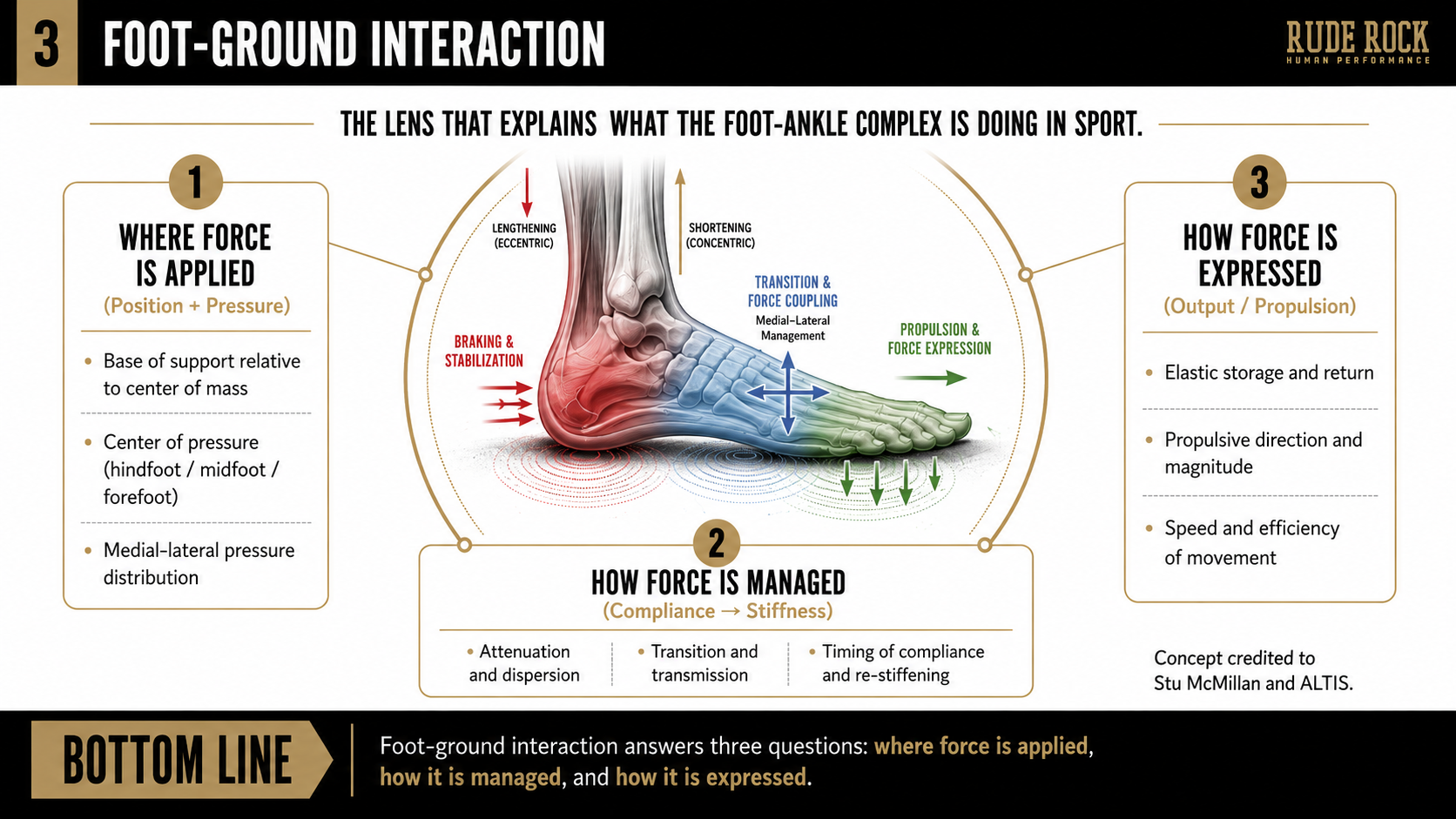
The first question is where. Where is force entering the foot? This is really a question about contact strategy. Where does the foot meet the ground relative to the athlete’s center of mass? Where does pressure enter the foot? Does the athlete have access to a centered base, or do they begin from a narrower or more lateralized entry? That first point of contact matters because it creates, or limits, the options that follow. A foot that meets the ground in a cleaner, more centered way generally has a better chance to organize load. A foot that starts laterally or rides the outside border immediately has less room to work from.
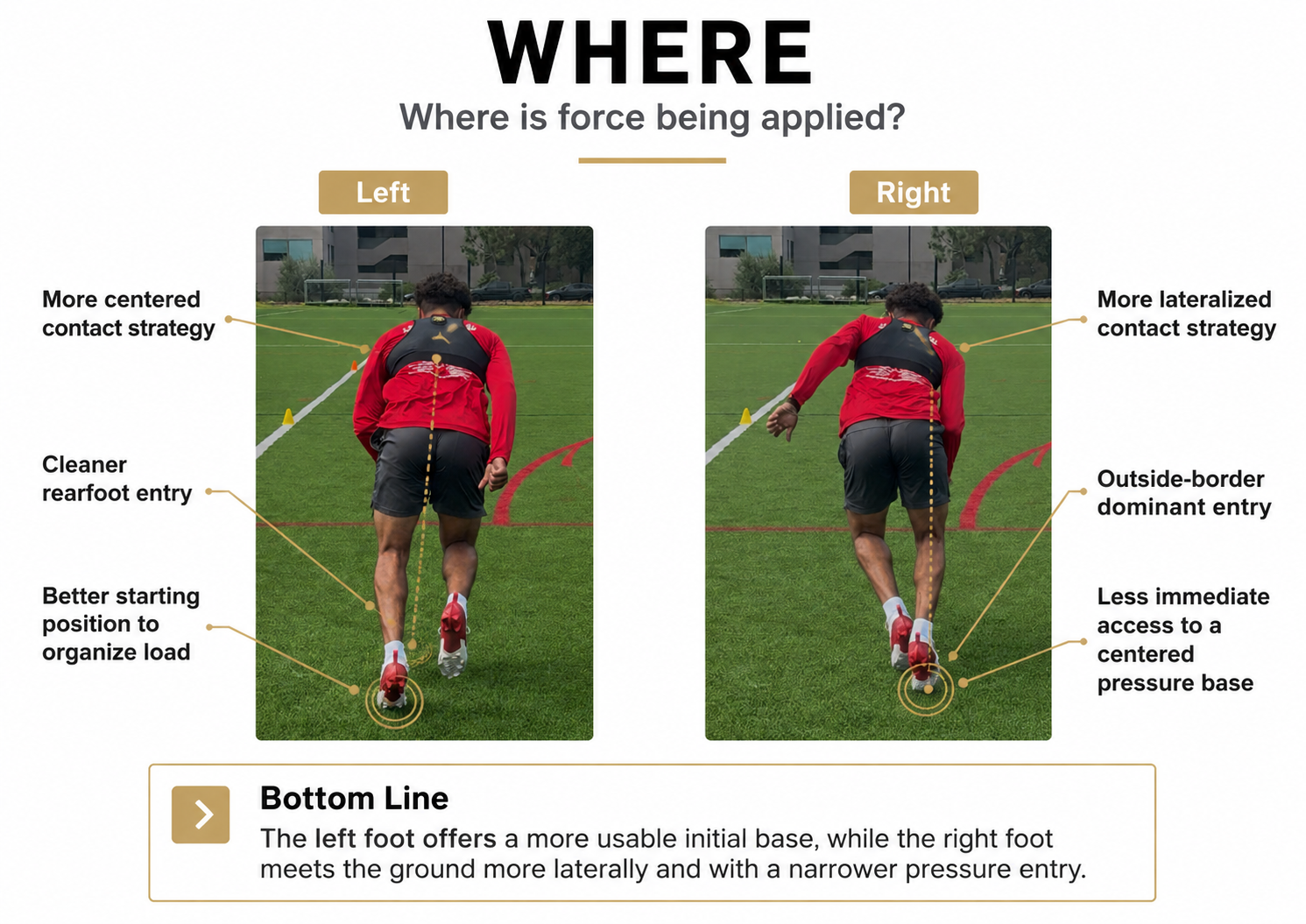
“WHERE: Initial contact strategy. The left foot presents a more centered entry and a more usable base, while the right foot shows a more lateralized, outside-border dominant entry.”
The second question is how. Once force enters the foot, how is it being managed? This is the transition phase, and in many ways it is the most important one. The foot has to yield enough to accept load, but not so much that it loses organization. It has to create enough compliance to attenuate force, then enough stiffness to pass that force forward. The real issue here is not softness or stiffness in isolation. It is the handoff between them.
This is also where a lot of contacts start to show their compensations. One side may move through stance with a cleaner tibia-foot relationship, while the other side may rely on more tibial rotation or a more pronounced midfoot pronation strategy to keep the contact alive. That does not automatically make one side “bad” and the other “good.” It simply tells us something about how the athlete is solving the problem. In the example below, the left side appears to manage the transition with more tibial external rotation and more visible midfoot pronation, while the right side looks more direct and more organized through the middle of stance.
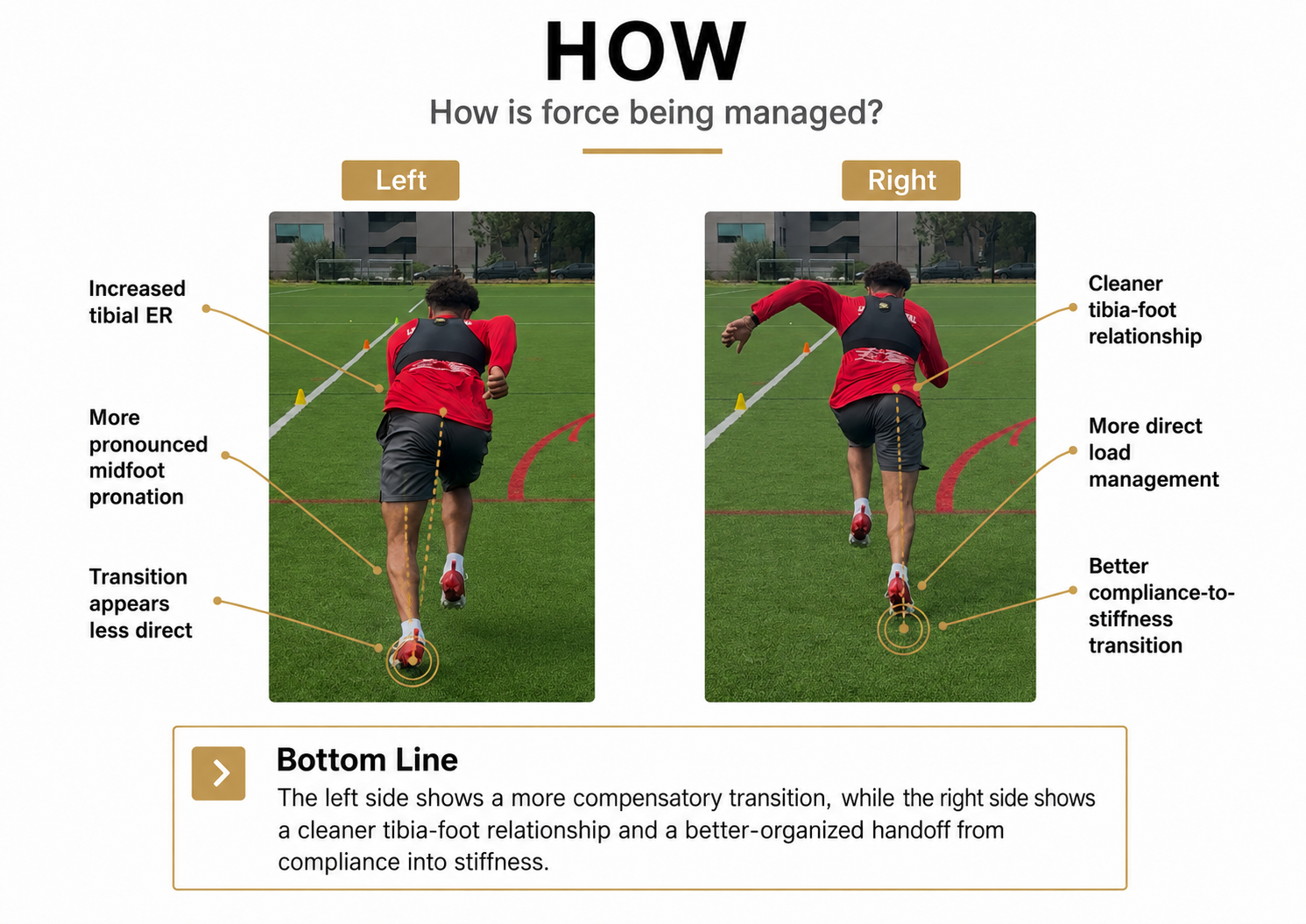
“HOW: Load management through the transition. The left side shows a more compensatory transition strategy, while the right side shows a cleaner tibia-foot relationship and a more direct compliance-to-stiffness handoff.”
The third question is when. When is force being expressed? This is the propulsion piece. By the time the foot reaches exit, it should be able to re-stiffen, shift pressure forward, and leave the ground with a clear enough finish to project the body forward. If that timing is off, the contact may look flat, delayed, or less decisive. The athlete may still move forward, but the exit will often tell you that the system never fully organized itself earlier in stance.
That is why push-off has to be interpreted carefully. It is tempting to judge propulsion as its own quality, but the push-off is often just the final expression of what happened before it. If the contact entered poorly or the transition got messy, the exit is left trying to salvage the rep. In the example below, the right side appears to organize propulsion more cleanly, while the left side looks slightly less direct and slightly later in how it finishes the contact.
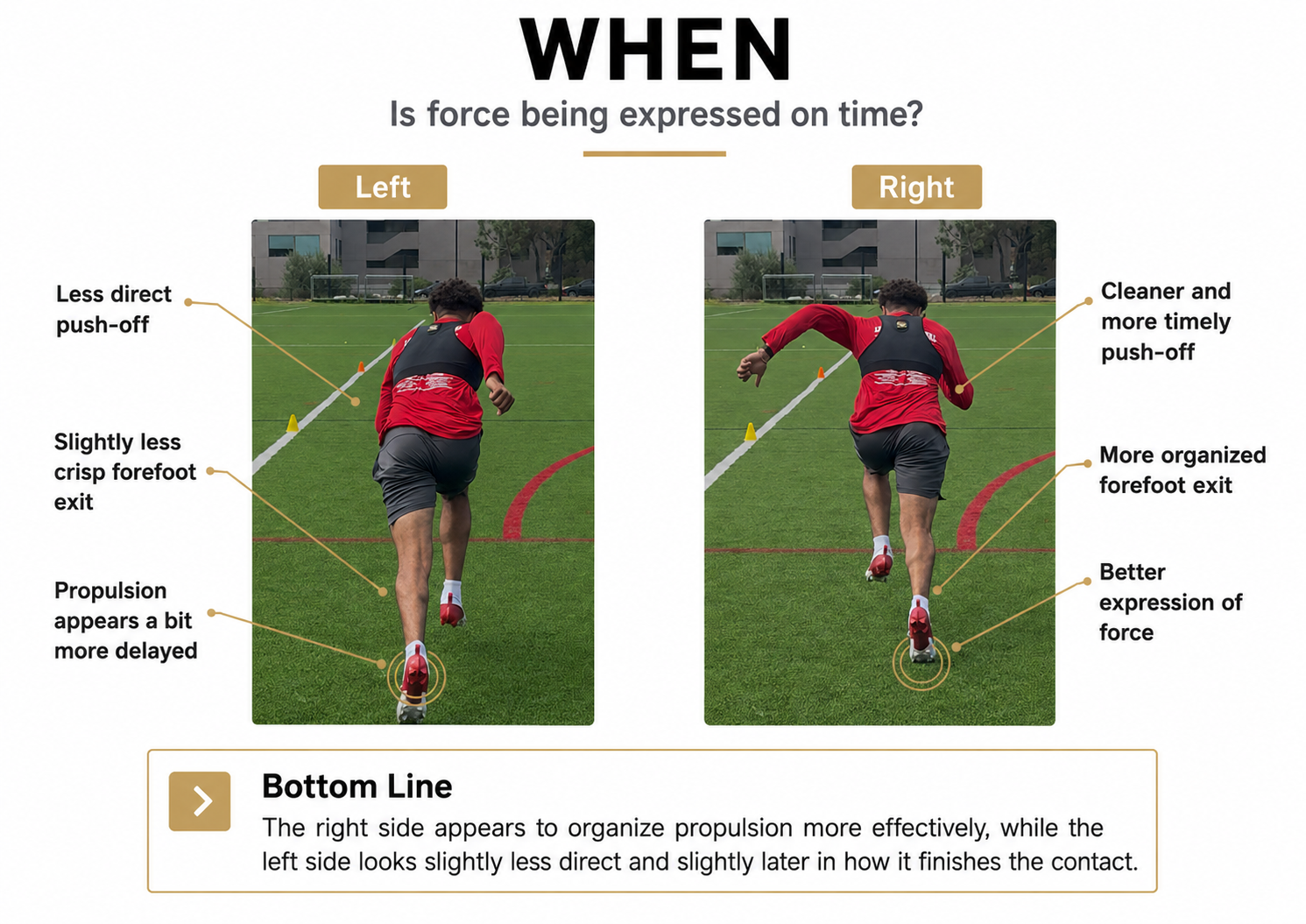
“WHEN: Timing and organization at propulsion. The right side shows a cleaner and more timely push-off, while the left side looks slightly less direct and slightly later at exit.”
This is one of the main reasons the foot is so often misread. We tend to focus on the most obvious thing: the painful tissue, the disappearing push-off, the collapsed arch, the part of the movement that looks least efficient. But the symptom site is not always the source. A flat push-off is not always a propulsion problem. Achilles or plantar irritation is not always a local tissue issue. Sometimes the more useful question is whether the athlete ever had a good enough entry point and a clean enough transition to give propulsion a chance in the first place.
The same logic applies to stiffness. Stiffness is not automatically the target, and it is not automatically a problem either. The better question is whether the foot becomes stiff at the right time. A foot that is stiff too early loses some ability to attenuate force. A foot that stays compliant for too long struggles to create a clean exit. The target is not maximum stiffness. The target is timely stiffness.
That timing piece is also why slow drills and isolated tests can sometimes hide what matters most. An athlete may look clean in a controlled setting, but the real question is whether the foot can organize itself under the speed, load, and complexity of the actual sporting task. Observation has to respect that. We should always try to watch the athlete in the context where the problem really exists.
At a practical level, the sequence is straightforward. Start by observing the whole contact, not just the push-off. Ask where force enters. Then ask how it is managed. Then ask whether the athlete expresses it on time. Use video, force data, or other tools to confirm and refine what you see, but do not let the tools replace the read. The eye should still guide the process.
The foot organizes force from the ground up. Our observation should follow that same path. Start with contact, work through the transition, and then judge the exit. That is the real foundation for observing the foot and ankle well: not chasing every visible symptom, not reducing the foot to mobility or stiffness alone, and not assuming the last thing you see is the first thing that went wrong.
THE PLAYBOOK
This article is part of the Coach’s Foot and Ankle Playbook series, built to help coaches better observe, interpret, and train the foot-ankle complex in real sporting movement. For the full framework, progressions, and coaching applications, check out the Coach’s Foot and Ankle Playbook here.

Foundations for Observing the Foot and the Ankle
The foot is easy to see and hard to read.
In sport, we can usually see when something looks off. We can see an athlete drift to the outside border of the foot, lose the arch, come off the ground too early, or struggle to create a clean push-off. We can also usually see where the symptoms show up later — calf tightness, Achilles irritation, plantar fascia discomfort, or a general sense that the athlete never quite looks clean at ground contact. The problem is that seeing a breakdown is not the same as understanding it. What shows up at the end of the contact is not always where the problem started.
That is the foundation for observing the foot and ankle well.
The foot-ankle complex is not just a passive base underneath the body. It is the first thing to meet the ground and the last thing to leave it. In that brief window, it has to accept load, organize pressure, transition force through the system, and then express that force back into the next action. Whether we are watching a sprint, a cut, a landing, or a change of direction, the same broad responsibility remains: the foot has to solve the ground well enough for the rest of the system to do its job.
For observation, I like to organize that responsibility into three questions: Where is force being applied? How is force being managed? When is force being expressed? Those questions correspond with three functional roles of the foot: attenuation, transmission, and expression. They are not three separate events. They are one continuous contact. That matters, because once the first part of the sequence breaks down, everything that follows is working off compromised information.
The first question is where. Where is force entering the foot? This is really a question about contact strategy. Where does the foot meet the ground relative to the athlete’s center of mass? Where does pressure enter the foot? Does the athlete have access to a centered base, or do they begin from a narrower or more lateralized entry? That first point of contact matters because it creates, or limits, the options that follow. A foot that meets the ground in a cleaner, more centered way generally has a better chance to organize load. A foot that starts laterally or rides the outside border immediately has less room to work from.
“WHERE: Initial contact strategy. The left foot presents a more centered entry and a more usable base, while the right foot shows a more lateralized, outside-border dominant entry.”
The second question is how. Once force enters the foot, how is it being managed? This is the transition phase, and in many ways it is the most important one. The foot has to yield enough to accept load, but not so much that it loses organization. It has to create enough compliance to attenuate force, then enough stiffness to pass that force forward. The real issue here is not softness or stiffness in isolation. It is the handoff between them.
This is also where a lot of contacts start to show their compensations. One side may move through stance with a cleaner tibia-foot relationship, while the other side may rely on more tibial rotation or a more pronounced midfoot pronation strategy to keep the contact alive. That does not automatically make one side “bad” and the other “good.” It simply tells us something about how the athlete is solving the problem. In the example below, the left side appears to manage the transition with more tibial external rotation and more visible midfoot pronation, while the right side looks more direct and more organized through the middle of stance.
“HOW: Load management through the transition. The left side shows a more compensatory transition strategy, while the right side shows a cleaner tibia-foot relationship and a more direct compliance-to-stiffness handoff.”
The third question is when. When is force being expressed? This is the propulsion piece. By the time the foot reaches exit, it should be able to re-stiffen, shift pressure forward, and leave the ground with a clear enough finish to project the body forward. If that timing is off, the contact may look flat, delayed, or less decisive. The athlete may still move forward, but the exit will often tell you that the system never fully organized itself earlier in stance.
That is why push-off has to be interpreted carefully. It is tempting to judge propulsion as its own quality, but the push-off is often just the final expression of what happened before it. If the contact entered poorly or the transition got messy, the exit is left trying to salvage the rep. In the example below, the right side appears to organize propulsion more cleanly, while the left side looks slightly less direct and slightly later in how it finishes the contact.
“WHEN: Timing and organization at propulsion. The right side shows a cleaner and more timely push-off, while the left side looks slightly less direct and slightly later at exit.”
This is one of the main reasons the foot is so often misread. We tend to focus on the most obvious thing: the painful tissue, the disappearing push-off, the collapsed arch, the part of the movement that looks least efficient. But the symptom site is not always the source. A flat push-off is not always a propulsion problem. Achilles or plantar irritation is not always a local tissue issue. Sometimes the more useful question is whether the athlete ever had a good enough entry point and a clean enough transition to give propulsion a chance in the first place.
The same logic applies to stiffness. Stiffness is not automatically the target, and it is not automatically a problem either. The better question is whether the foot becomes stiff at the right time. A foot that is stiff too early loses some ability to attenuate force. A foot that stays compliant for too long struggles to create a clean exit. The target is not maximum stiffness. The target is timely stiffness.
That timing piece is also why slow drills and isolated tests can sometimes hide what matters most. An athlete may look clean in a controlled setting, but the real question is whether the foot can organize itself under the speed, load, and complexity of the actual sporting task. Observation has to respect that. We should always try to watch the athlete in the context where the problem really exists.
At a practical level, the sequence is straightforward. Start by observing the whole contact, not just the push-off. Ask where force enters. Then ask how it is managed. Then ask whether the athlete expresses it on time. Use video, force data, or other tools to confirm and refine what you see, but do not let the tools replace the read. The eye should still guide the process.
The foot organizes force from the ground up. Our observation should follow that same path. Start with contact, work through the transition, and then judge the exit. That is the real foundation for observing the foot and ankle well: not chasing every visible symptom, not reducing the foot to mobility or stiffness alone, and not assuming the last thing you see is the first thing that went wrong.
THE PLAYBOOK
This article is part of the Coach’s Foot and Ankle Playbook series, built to help coaches better observe, interpret, and train the foot-ankle complex in real sporting movement. For the full framework, progressions, and coaching applications, check out the Coach’s Foot and Ankle Playbook here.
YOUTUBE
Share Our YouTube Channel



Movement Literacy Concepts - Kinetic [02:16]
The final piece of our movement literacy framework addressing...

Trunk & Spine [01:40]
Basic spinal mechanics and how they relate to movement...

Movement Literacy - Hips [02:13]
Addressing the basics of hip movement in our framework...
Movement Literacy - Foot [01:49]
Part 1 of our movement literacy framework covering mechanics...

Shoulder Mechanics [01:46]
Fourth segment covering basic shoulder mechanics...

Trunk/Bracing [03:36]
Learn key trunk bracing techniques for safe movement...

Shoulder/Scapula [02:32]
Scapula mechanics and shoulder stability fundamentals...

Movement Literacy [02:57]
An overview of essential movement literacy concepts...
Optimizing Feet & Ankles [01:37]
Techniques to improve foot and ankle performance...
Foot & Ankle Coaching [02:02]
Effective coaching and cueing for foot and ankle...
Basic Foot & Ankle Functions [02:28]
Understanding the fundamental functions of foot and ankle...
Cueing & Coaching the Neck [02:24]
Learn neck movement and coaching strategies...

Human First Newsletter
Human First is a weekly note on the parts of high performance that have nothing to do with training leadership, decision-making, self-awareness, and navigating the demands of work and life with more clarity and intent.
Our technical coaching, rehab, and athlete-management content still lives on the website; this is where we think out loud about everything around it.
©2026 Rude Rock Strength and Conditioning, LLC